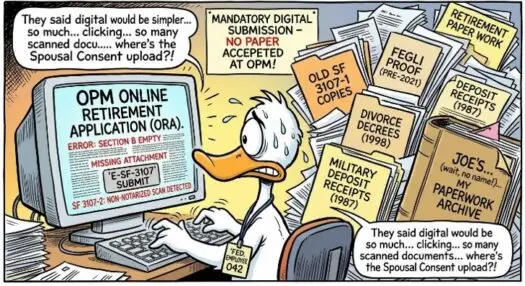
For generations of dedicated public servants, the road to a well-earned retirement was paved with a very specific, monumental stack of paper. At the absolute center of that paper fortress sat Standard Form 3107—the Application for Immediate Retirement under the Federal Employees Retirement System (FERS). It was a form to be treated with immense care, filled out at kitchen tables with a fine-point pen, where a single cross-out mistake or a smudge of white-out on a spousal consent page could instantly reject your application and delay your first pension check for agonizing months. Now, we move through 2026, the Office of Personnel Management (OPM) has instituted a profound structural shift that fundamentally changes how an American Federal Employee steps away from public service. The age of the physical manila envelope is officially over. OPM has transitioned from traditional paper submissions to its fully mandatory digital platform:
NOW: Online Retirement Application (ORA).
Is the E-SF-3107 Fully Functional?
To put it plainly: Yes, the electronic application system is fully functional, completely mandatory, and paper submissions have been phased out.
However, as any seasoned federal worker knows, “functional” in Washington does not mean you simply log on and click a button on your last day of work. The system relies entirely on a strict, gated sequence managed by your agency’s Human Resources department.
A Federal Employee cannot simply log in to OPM and start an application on their own. The modernized process operates in a specific, digital order:
- The Gated Launch: You must first formally notify your agency HR specialist that you intend to retire.
- The Profile Build: Your agency verifies your baseline retirement eligibility and builds your unique profile within the ORA portal.
- The Pre-Filled Handoff: Only after HR triggers this process will you receive a secure link via Login.gov to access your personal dashboard.
The system then guides you through a step-by-step electronic wizard. The greatest victory of the new platform is that it automatically pre-fills your personal and payroll data straight from official agency archives. It features built-in, real-time error checking, which means the system physically blocks you from submitting if you leave a mandatory field blank or input conflicting dates.
What Has Changed in the Process?
Aside from moving from a desk to a computer screen, the structural boundaries of retirement choices remain intact, but the way errors are caught has changed entirely.
- No More Manual Tracing: Under the old method, an employee had to manually map out decades of service. Now, the ORA platform pre-populates your historical milestones.
- Elimination of the Processing Black Hole: Previously, once you handed your paper packet to HR, it vanished into a bureaucratic black hole for months. The 2026 ORA system features a real-time tracking dashboard, allowing a Federal Employee to log in and see exactly whether their application is sitting with their agency HR, payroll, or if it has safely landed at OPM for final processing.
What Documents Must Accompany the Electronic Application?
While the core application is digitized, bureaucratic validation still requires cold, hard proof. The ORA system requires you to digitally upload clean, high-resolution scans of vital life documents. A Federal Employee must ensure the following attachments accompany the electronic submission to avoid catastrophic processing backlogs:
- SF 3107-2 (Spousal Consent): If you are married and elect anything less than the maximum possible survivor annuity for your spouse, this remains a strict legal requirement. It must be printed, physically signed by your spouse, legally notarized, and uploaded flawlessly with zero manual corrections or cross-outs.
- Certified Summary of Federal Service (SF 3107-1): This must be reviewed, certified by your agency HR, and electronically attached to verify your total creditable years of service.
- Proof of Insurance Continuity: Documentation proving you have maintained continuous coverage under the Federal Employees Health Benefits (FEHB) and Federal Employees’ Group Life Insurance (FEGLI) programs for the immediate 5 years prior to retirement to successfully carry those benefits into your post-career life.
- Vital Statistics: Certified copies of your marriage certificate, any relevant federal court-ordered divorce decrees, or former spouse survivor benefit agreements.
- Military Service Documentation: If you performed military service and completed a post-1956 military deposit to credit those years toward your civilian pension, a copy of your DD-214 and the official payment receipts must accompany the upload.
The digital transition is a massive technological leap forward meant to clear decades of paper-shuffling backlogs. Yet, the ultimate rule of the federal bureaucracy remains unchanged: the machine is only as good as the data you give it. A Federal Employee must still double-check every pre-filled date and verify every scanned attachment, ensuring that their march toward retirement is protected by absolute accuracy.
